

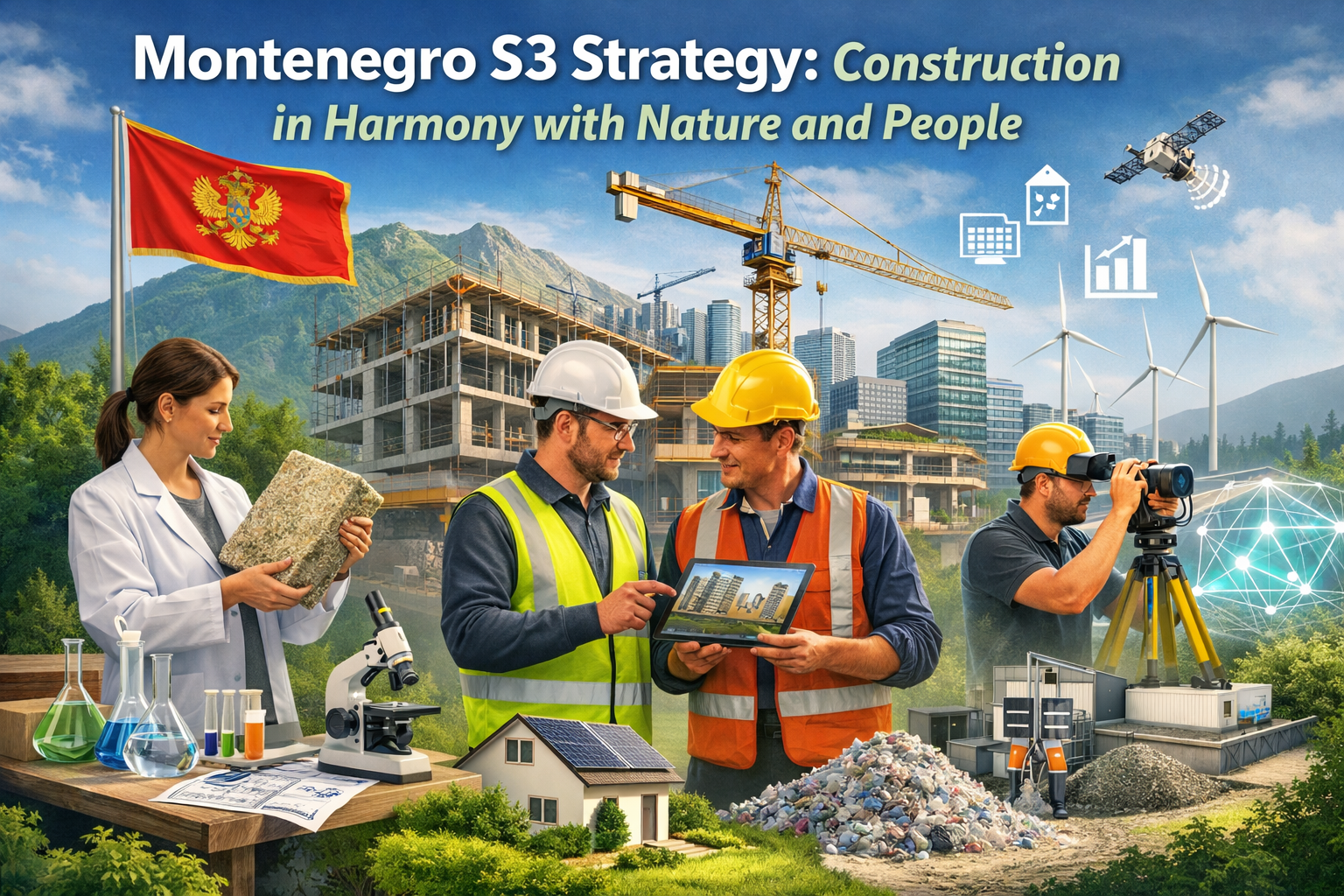
New Montenegrin S3 Strategy creates research and innovation opportunities for construction industry
Montenegro’s Smart Specialization Strategy (S3 Strategy) is a national-level document coordinated by the Ministry of Education, Science and Innovation. The key institution of operational and financial support for innovation activities is the Innovation Fund of Montenegro, through the implementation of the innovation and startup ecosystem support program. The Fund implements programs for financing innovation projects, including support for the development of startup companies, the commercialization of research results and the development of innovative products and services, which contributes to strengthening cooperation between the scientific research sector and the economy, as well as to the development of innovation culture in society.
The Smart Specialization Strategy functions as an umbrella strategic document in the field of innovation and development, unifying various sectoral and horizontal policies and harmonizing them with national and European strategic frameworks. Thus, the Strategy becomes a key instrument for strategic planning and monitoring the development of the national innovation system, ensuring consistency and continuity in the achievement of development priorities at all levels. On the other hand, the Montenegrin S3 strategy is of particular importance in the context of the process of accession to the European Union, as it represents a key instrument for harmonizing the national innovation and industrial policy with the strategic framework of the EU.
In the first round of the “Smart Specialization Strategy of Montenegro 2019-2024” the Construction industry was not identified as the priority area, but it was partly mentioned in the area of “Energy and sustainable environment”. As a result, during that period the Innovation Fund of Montenegro co-financed three projects under the Collaborative Grants Programme, totaling more than €0,5M investment, which have significant applications in the construction sector, also confirming the relevance of cross-sectoral innovation. Due to it, one of the projects named “New environmentally friendly thermal insulation materials based on ash and waste plastic” is now executed by private Montenegrin entrepreneur “Mont Way DOO Podgorica” in collaboration with the Faculty of Metallurgy and Technology of the University of Montenegro. It is expected that the optimal recipe for the production of this material will be developed as part of the project, which will use plastic waste and industrial waste from the Thermal Power Plant in Plevlja in the production of the new building material which can be offered to the Montenegrin construction market.
Recently the Government of Montenegro has adopted a new “Smart Specialisation Strategy of Montenegro 2026–2031”, together with the Action Plan for the period 2026–2027. In this round S3 already includes the construction sector as the priority area with one of the greatest development and market potential. The formulation of the strategic priority is identified as “Construction in Harmony with Nature and People” and the vision of this area is described as “To increase the competitiveness and added value of the construction sector through technological modernization, digital transformation and the application of sustainable and innovative solutions”.
The just published S3 identifies structural weaknesses in the construction sector — lack of skilled workforce, limited innovation and digitalization, and insufficient institutional support — as critical barriers to competitiveness. To overcome these, the strategic goal is to increase the sector’s added value through technological modernisation, digital transformation, and sustainable solutions, measured by growth in gross value added. Key sector priorities include establishing a functional e‑business system for issuing construction permits to improve transparency and efficiency, strengthening the institutional‑regulatory framework and human capacities to enable widespread adoption of digital tools such as BIM and GIS, and embedding continuous training programmes to build digital skills. Together, these priorities aim to modernise processes, reduce costs and risks, foster innovation, and position Montenegro’s construction sector as a competitive and sustainable driver of economic growth.